In 2026, the e-commerce landscape is more competitive than ever. High customer acquisition costs and rising platform fees mean that simply increasing sales is not always enough. To build a sustainable brand, you must focus on your bottom line. While a typical Shopify store targets a 30-40% gross margin, the real challenge lies in protecting that net profit after all overhead is paid.
In this guide, we dive into the latest 2026 data and provide 10 actionable strategies to help you squeeze every cent of profit out of your Shopify store without sacrificing customer experience.
- 1. Master Upselling and Cross-Selling
- 2. Implement Smart Product Bundling
- 3. Optimize Free Shipping Thresholds
- 4. Leverage High-ROI Email Marketing
- 5. Optimize Page Speed for Conversions
- 6. Build Recurring Revenue with Subscriptions
- 7. Avoid the "Discount Trap"
- 8. Slash Costs with Shopify Shipping
- 9. Audit Your App Overhead
- 10. Choose the Right Plan for Transaction Fees
- 2026 Shopify Profit Benchmarks
1. Master Upselling and Cross-Selling
Upselling (offering a premium version) and cross-selling (offering related products) are the most direct ways to increase your Average Order Value (AOV). Data shows that personalized upsell offers can increase total revenue by 10% to 30%.
According to research, a well-timed upsell email can increase the average order amount by approximately 28%. Instead of just trying to get more customers, focus on getting your current customers to spend more during each visit.
2. Implement Smart Product Bundling
Product bundling encourages customers to buy multiple items at a slightly discounted total price compared to buying them separately. This increases the total units per transaction and helps offset fixed shipping costs.
Mağazaların paket (bundle) satışı uygulaması durumunda AOV genelde %20-30 oranında yükselmektedir. This strategy is particularly effective for beauty, health, and home decor categories where complimentary items are easily identified.
3. Optimize Free Shipping Thresholds
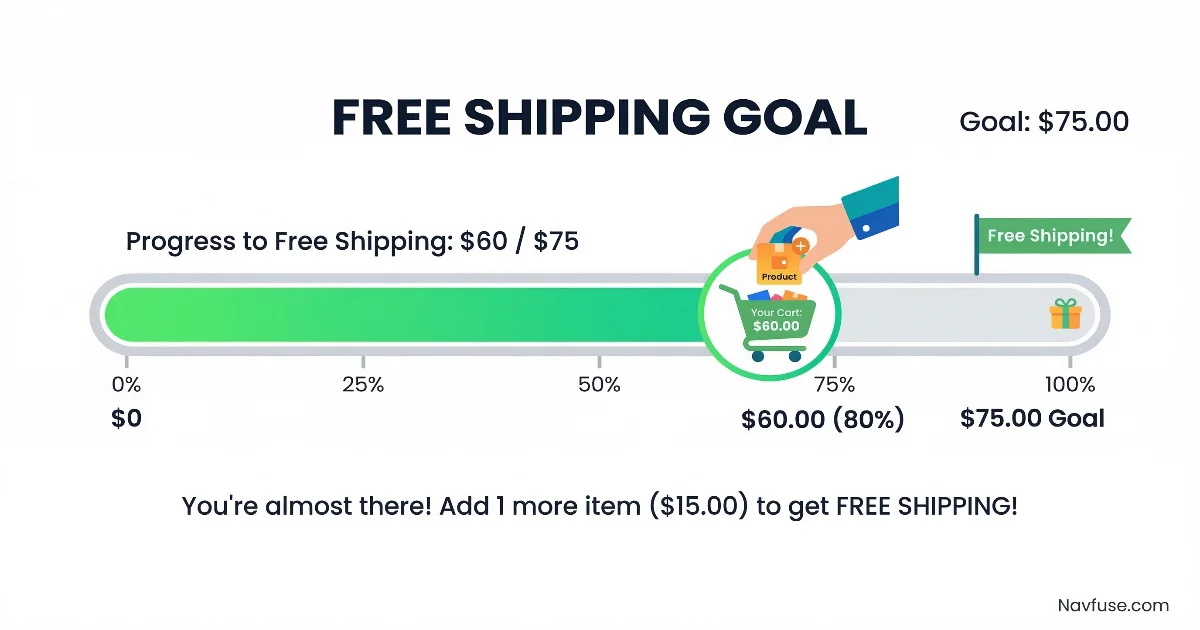
Free shipping is the #1 incentive for shoppers to complete a purchase. However, offering it on every order can kill your margins. The secret is setting a threshold (e.g., "Free shipping over $75").
Research indicates that 58% of customers will add another item to their cart just to reach a free shipping threshold. On average, this practice increases AOV by 30%, effectively turning a shipping expense into a growth driver.
4. Leverage High-ROI Email Marketing
In 2026, email remains the king of ROI. For every $1 spent on email marketing, Shopify stores see an average return of $42. This is a 4200% ROI that social media ads simply cannot match.
Automated abandoned cart flows and segmented campaigns (targeting customers based on previous behavior) can boost revenue by up to 760%. Protecting your margin means spending your marketing budget where it works hardest.

5. Optimize Page Speed for Conversions
Profit is tied to conversion rate. If your site is slow, you are paying for traffic that leaves before they even see your products. A 1-second delay in page load time can drop your conversion rate by 7%.
Optimizing images, reducing unnecessary app scripts, and using a high-performance Shopify theme are essential 2026 hygiene factors. Faster sites lead to higher conversion rates, which lowers your effective cost per acquisition (CPA).
6. Build Recurring Revenue with Subscriptions
The cost to acquire a new customer is up to 5x higher than retaining an existing one. Subscriptions solve this by creating regular revenue cycles. Adoption of subscription models on Shopify has increased by 33% year-over-year in 2025-2026.
Whether it is replenishables like coffee or a discovery box, recurring revenue stabilizes your cash flow and significantly increases the Lifetime Value (LTV) of your customers.
7. Avoid the "Discount Trap"
Constant discounting train your customers to wait for a sale and erodes your brand value. More importantly, it destroys your margin. If an item has a 40% gross margin and you give a 20% discount, your margin doesn't just cut by 20% - it is halved.
Instead of blanket discounts, use value-adds (like a small free gift) or loyalty points to encourage sales without slashing your prices.
8. Slash Costs with Shopify Shipping
Shipping costs typically represent 10-15% of total order value. One of the easiest ways to improve your margin is to use the deeply discounted rates provided by Shopify Shipping.
| Carrier | Max Discount | Region |
|---|---|---|
| USPS | 88% | USA |
| DHL Express | 80% | International |
| Canada Post | 58% | Canada |
| Sendle | 44% | Australia |
By leveraging these bulk rates instead of retail prices, you can save several dollars per package, which flows directly into your net profit.
9. Audit Your App Overhead
The "app creep" is real. Most Shopify stores use 5-8 apps, with monthly costs ranging from $5 to $50 each. Small stores often spend $100-$200 per month purely on app subscriptions, while larger Plus stores can spend thousands.
Every quarter, perform an app audit. If an app isn't directly generating revenue or saving significant time, delete it. This not only saves money but also improves your page speed.
10. Choose the Right Plan for Transaction Fees
As your volume grows, the cheapest plan can become the most expensive due to transaction fees. If you don't use Shopify Payments, you pay 2% on Basic, 1% on Grow, and 0.6% on Advanced.
When your monthly sales grow, switching to a higher plan can pay for itself through lower transaction fees alone. This is where strategic calculation becomes a profit center.
2026 Shopify Profit Benchmarks
How do you compare to other sellers? Here are the industry benchmarks for 2026 based on recent market data:
| Metric | Average Store | Top 10% Performers |
|---|---|---|
| Conversion Rate | 1.4% | 4.7% |
| AOV (Average Order Value) | $85 - $95 | $150+ |
| Gross Profit Margin | 30% - 40% | 55%+ |
| Net Profit Margin | ~10% | 20%+ |
| Cart Abandonment Rate | 70.2% | Under 60% |
If your net profit margin is below 5%, it is time to look closely at your overhead and shipping costs. High-performing stores succeed not by just selling more, but by keeping more of every dollar earned.
Profit is what remains after you stop guessing. By optimizing your shipping, auditing your apps, and focusing on AOV-boosting strategies like bundling and threshold-based free shipping, you can realistically increase your net margin by 5-10% without a single new customer.
