
A single corporate job posting receives 207 to 258 applications on average in 2025-2026 (HR Dive / Employ, 2026). Remote-friendly roles get hit even harder - customer service positions can attract 1,000+ applicants in the first week, and tech roles regularly exceed 2,000. Your resume has roughly 30 to 60 seconds to survive the initial scan before a recruiter moves to the next candidate.
This guide cuts through the noise with verified data from recruiter surveys, eye-tracking studies, and ATS vendor documentation. No recycled myths, no vague advice - just the numbers that matter and the design decisions they support. Whether you are applying for your first job or repositioning after 15 years, these insights will help you build a resume that gets read.
| Metric | Value | Source |
|---|---|---|
| Applications per corporate job (2025) | 257.6 | HR Dive / Employ |
| Fortune 500 companies using ATS | 97.8% | Jobscan (2025) |
| Recruiters spending under 2 min on initial scan | 72% | Zety (2024) |
| Resumes rejected for poor formatting | 72% | Zety (2024) |
| Hiring managers who would reject AI-generated resumes | 49% | Resume.io (2025) |
1. How Recruiters Actually Read Your Resume
The famous "6-second resume scan" has become career advice gospel, but the real data tells a more nuanced story. A 2018 eye-tracking study by The Ladders found recruiters form an initial impression in 7.4 seconds, but that measures the first glance - not the total review time.
More recent surveys paint a clearer picture. Zety's 2024 survey of 753 recruiters and Kickresume's 2026 study of 1,004 global participants both show that most recruiters spend significantly more time than the "6-second" myth suggests.
| Time Range | Zety (2024) | Kickresume (2026) |
|---|---|---|
| Under 10 seconds | 3% | 6% |
| 10 - 30 seconds | 19% | 18% |
| 30 - 60 seconds | 17% | 28% |
| 1 - 3 minutes | 33% | 30% |
| 3+ minutes | 28% | 18% |
Key insight: the first 30-60 seconds determine everything. If your resume passes that window, you typically get one to three full minutes of attention. Fail it, and you are part of the 22% scanned in under 30 seconds.
What Recruiters Look at First
Zety's 2024 recruiter survey asked "What is the first section you look at?" The results challenge the assumption that work experience always comes first.
| Section | Percentage |
|---|---|
| Skills | 39% |
| Work Experience | 37% |
| Professional Summary / Objective | 15% |
| Education / Certifications | 9% |
This means your skills section is the single most important area of your resume. Place it prominently, align it with the job description keywords, and make it scannable at a glance.
Instant Rejection Triggers
Even qualified candidates get eliminated before their experience is evaluated. Here are the triggers that cause immediate rejection, ranked by percentage.
| Rejection Trigger | Percentage | Source |
|---|---|---|
| Lies or exaggeration detected | 76% | Zety (2024) |
| Poorly formatted (inconsistent fonts, alignment) | 72% | Zety (2024) |
| Not customized for the specific role | 72% | Zety (2024) |
| Typos and grammar errors | 68% | Zety (2024) |
| Unprofessional email address | 61% | Zety (2024) |
| Overly designed / "Canva-style" heavy graphics | 20% | Enhancv (2025) |

2. ATS: What It Actually Does (and What It Does Not)
The claim that "ATS automatically rejects 75% of resumes" is one of the most persistent myths in career advice. Here is what the data actually shows.
ATS Adoption: Nearly Universal in Large Companies
Jobscan's 2025 analysis of Fortune 500 companies found that 97.8% (489 out of 500) use a detectable ATS. This rate has remained consistently above 97% since 2018. If you are applying to any mid-size or large company, your resume will go through an ATS.
| ATS Platform | Fortune 500 | General Market (12,820 companies) |
|---|---|---|
| Workday | 39%+ | 15.9% |
| SAP SuccessFactors | 13.4% | - |
| Greenhouse | - | 19.3% |
| Lever | - | 16.6% |
| iCIMS | - | 15.3% |
The Auto-Rejection Myth - Debunked
Enhancv's 2025 study interviewed 25 recruiters specifically about how their ATS handles applications. The results are eye-opening.
| ATS Behavior | Percentage |
|---|---|
| No automatic rejection based on format or content | 92% |
| Active content-based auto-rejection | 8% |
| Knockout questions used (work permit, license, location) | 100% |
| AI/fit score available in system | 44% |
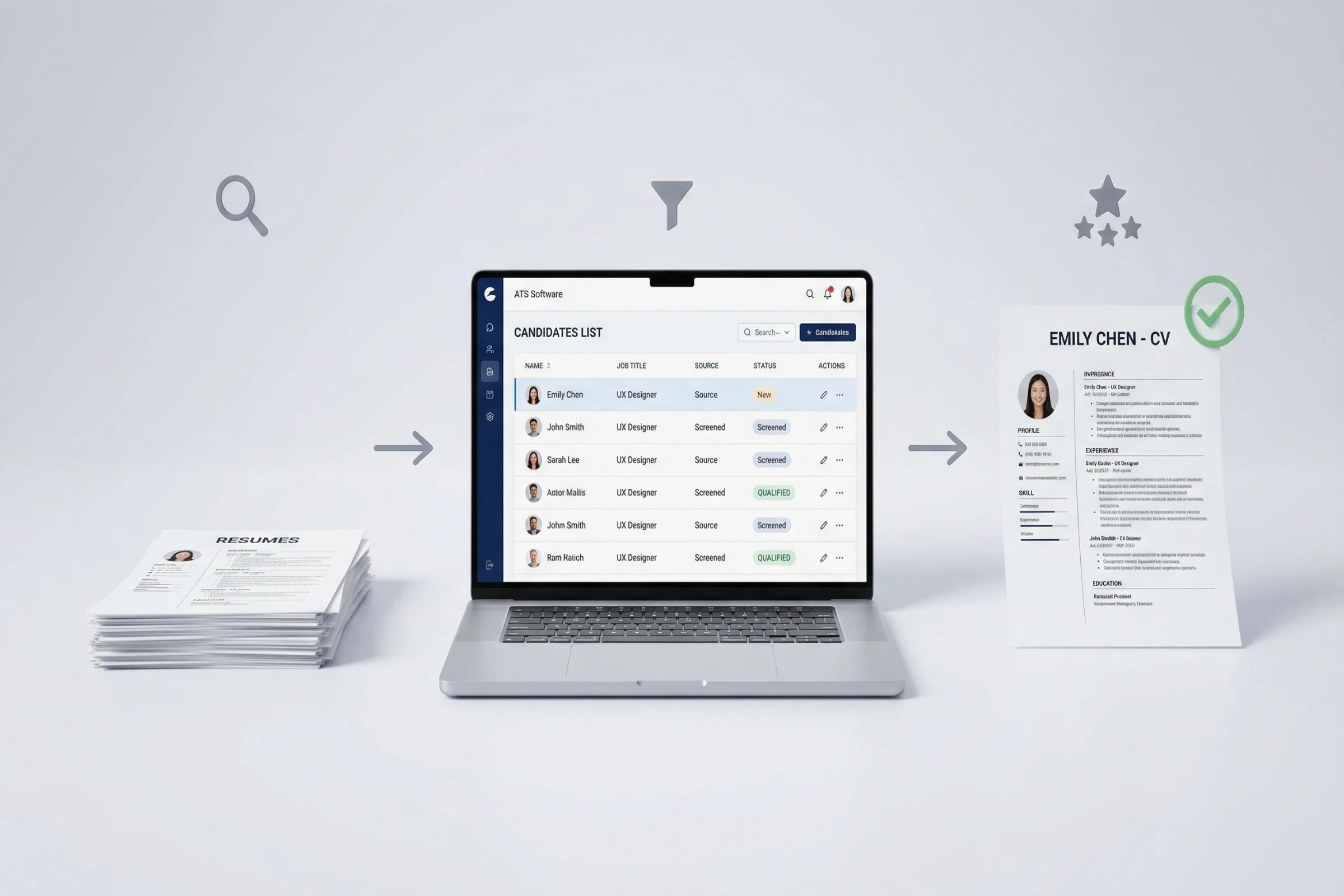
The real risk is not rejection - it is invisibility. When a recruiter searches for "project manager with Agile certification" and your resume does not contain those keywords, you simply never appear in their results. In a pool of 250+ applicants, being ranked at position 200 is functionally identical to being rejected.
3. ATS-Friendly Resume Formatting
Since ATS systems parse your resume into structured data, certain design elements can cause information to be lost or misread. Here is what each major ATS platform accepts and what to avoid.
File Format Compatibility
| ATS Platform | Supported Formats |
|---|---|
| Greenhouse | .doc, .docx, .pdf, .rtf, .txt |
| Lever | .docx, PDF, RTF, HTML, OpenOffice (ODF) |
| Workable | .pdf, .doc, .docx, .rtf, .html, .odt |
| Workday | DOC, DOCX, HTML, PDF, TXT (5MB max) |
| SmartRecruiters | PDF, DOC(X), RTF, JPG, PNG |
Safe choice: submit as .docx for maximum parse accuracy, or a text-based PDF (not image-scanned). Avoid Canva exports and "designed" PDFs with embedded graphics that cannot be text-selected.
Design Elements to Avoid
| Element | Risk | Recommendation |
|---|---|---|
| Headers and footers | Content may not be parsed | Place all content in the main body |
| Tables and multi-column layouts | Reading order gets scrambled | Use single-column layout |
| Image-only resume / infographic CV | Text is completely invisible to ATS | Always use selectable text |
| Icons, graphics, and skill bars | Ignored by parser, wastes space | Use plain text skill lists |
| Unusual fonts | May render incorrectly | Use Inter, Calibri, Arial, or Garamond |
4. 2026 Resume Design: Length, Layout, and Style
Resume design is not about being creative - it is about being scannable. Every design decision should serve one goal: making it easy for a recruiter to find the information they need in 30 seconds.
Resume Length: One Page or Two?
Two major 2024 recruiter surveys give seemingly contradictory results on this question, but the nuance matters.
| Question | Result | Source |
|---|---|---|
| Recruiters who prefer 2-page resumes | 57% | Zety (2024) |
| Recruiters who prefer 1-page resumes | 37% | Zety (2024) |
| Recruiters who recommend 1 page for average job seekers | 92% | ResumeGo (2024) |
| Experience needed for 2 pages: 10+ years | 45% | ResumeGo (2024) |
| Experience needed for 2 pages: 15+ years | 17% | ResumeGo (2024) |
| Experience needed for 2 pages: 20+ years | 31% | ResumeGo (2024) |
| "More than 2 pages is excessive" | 59% | ResumeGo (2024) |
The rule: use one page if you have under 10 years of experience. Use two pages if you have 10+ years and every line adds value. Never exceed two pages. And perhaps most importantly: avoid "irregular" lengths.
The Irregular Page Length Problem
A resume that spills onto a second page with just a few lines looks unfinished. ResumeGo found that 67% of recruiters frequently encounter these "1.5-page" resumes, and 84% recommend adjusting content to hit clean page breaks. 61% said irregular length negatively impacts their impression of the candidate.
What Recruiters Value in Design
Enhancv's 2025 recruiter interviews reveal a clear hierarchy of design priorities.
| Design Element | Recruiter Agreement |
|---|---|
| Clear, skimmable structure | 92% |
| Relevant experience and skills | 88% |
| Natural keyword usage (not stuffing) | 76% |
| Short bullet points instead of paragraphs | 72% |
| Simple, consistent formatting | 68% |
| 1-2 page length | 64% |
5. Resume Content: What to Write and How
Quantifiable Results Are Non-Negotiable
Zety's 2024 survey found that 89% of recruiters are less likely to consider a resume without quantifiable results. Only 11% said the absence of metrics does not affect their decision.
Instead of "Managed a sales team," write "Led a 12-person sales team that exceeded quarterly targets by 23%, generating $1.4M in new revenue." Numbers create credibility and make your achievements concrete.
Employment Gaps
Employment gaps remain a sensitive area. In Zety's 2024 survey, 95% of recruiters consider gaps a red flag (75% agree, 20% strongly agree). However, the key finding is how candidates should address them.
| Method | Recruiter Preference |
|---|---|
| Explain in cover letter | 57% |
| Discuss in interview | 49% |
| Address directly on resume | 44% |
The takeaway: do not try to hide gaps. A brief, honest explanation (caregiving, education, career transition) is always better than a suspicious blank space.
6. AI in Hiring: How Companies Screen in 2026
AI screening has moved far beyond simple keyword matching. The adoption curve is steep, but the way AI is used varies significantly across organizations.
| Metric | Percentage | Source |
|---|---|---|
| Recruiters using AI or automated screening tools | 96% | MyPerfectResume (2024) |
| Companies using AI for resume review | 82% | ResumeBuilder.com (2024) |
| HR departments with AI adoption (2025) | 43% | SHRM (2025) |
| Recruiters who "always" use AI in screening | 26% | MyPerfectResume (2024) |
| Companies using AI chatbots for candidate communication | 40% | ResumeBuilder.com (2024) |
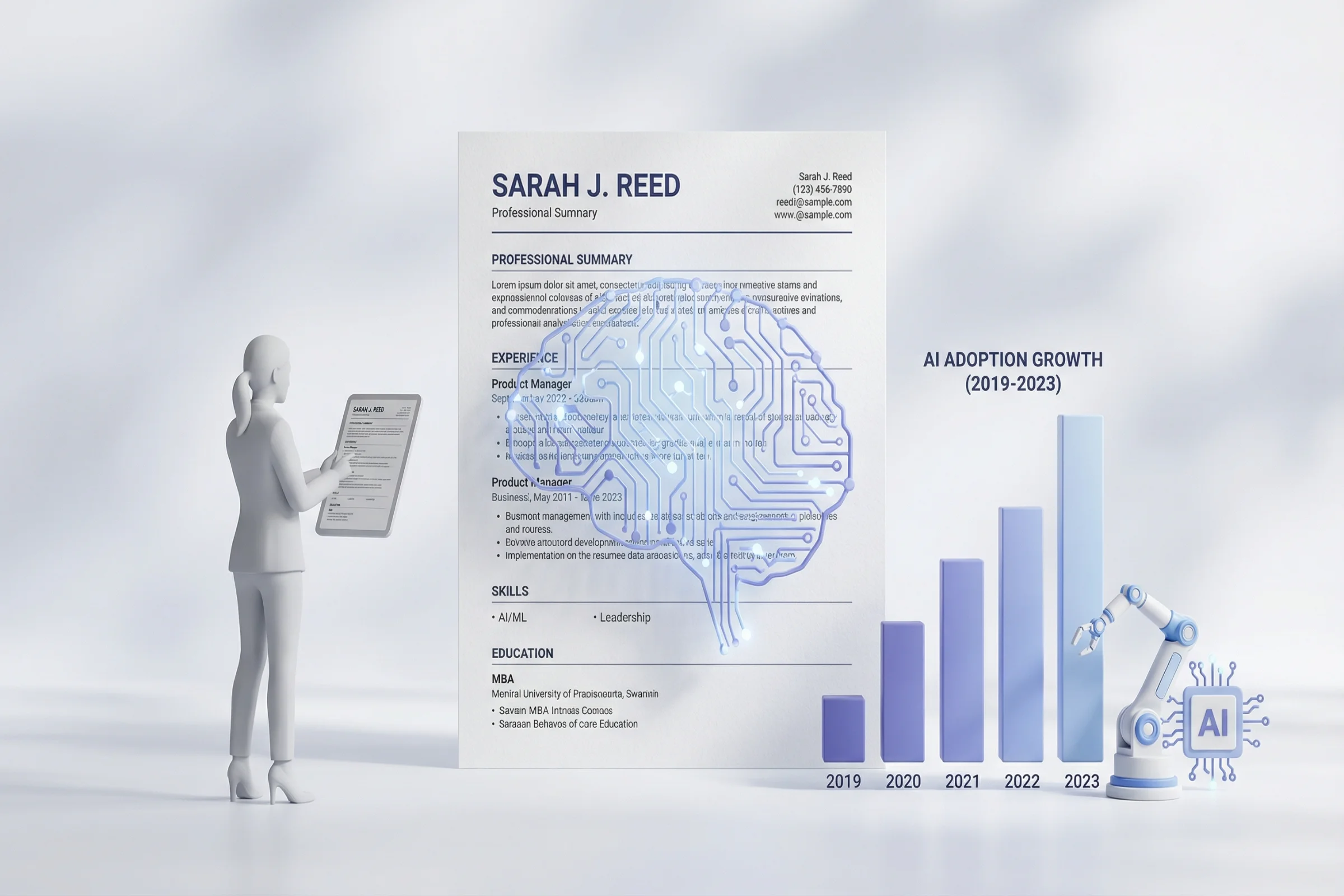
The distinction between "ATS" and "AI screening" matters: ATS stores, parses, and lets recruiters search. AI adds scoring, ranking, and automated assessments on top of ATS. Enhancv's research found that even when AI match scores exist, most recruiters treat them as signals, not verdicts.
AI-Generated Resumes: The Detection Problem
The rise of ChatGPT has created a new tension in hiring. A 2025 Resume.io study found that 49% of hiring managers would automatically eliminate a resume they believe was AI-generated. The strongest stance came from Iowa (71% auto-reject), while New Hampshire was most lenient (20%).
Recruiters specifically report recognizing "ChatGPT formatting patterns" - generic phrasing, identical structures across candidates, and claims that sound polished but lack verifiable specifics. The safe approach: use AI for initial drafts and suggestions, then heavily customize with your personal metrics, company-specific language, and authentic voice.
7. Remote Work and Location Signals on Your Resume
The remote work landscape has shifted dramatically. LinkedIn's 2025 Economic Graph report shows that while remote job postings in the US dropped to roughly 8% of total listings, they attract 35% of all applications (Business Insider, 2025). This creates intense competition for remote roles.
| Metric | Value | Source |
|---|---|---|
| Remote job postings (US, Sep 2025) | ~8% | Business Insider / LinkedIn |
| Applications going to remote jobs | 35% | Business Insider / LinkedIn |
| Recruiters who say remote improved candidate quality | 83% | MyPerfectResume (2024) |
| Recruiters more willing to consider other locations | 92% | MyPerfectResume (2024) |
| Recruiters who still prefer local candidates | 96% | MyPerfectResume (2024) |
The paradox: 92% of recruiters are more open to remote candidates, but 96% still have some level of local preference. When listing your location, signal flexibility: "San Francisco, CA (open to remote/hybrid)" covers both bases. If you are fully remote, include your timezone to reduce friction.
8. The Bottom Line
Building a perfect resume in 2026 is not about following a template - it is about understanding how your resume will be processed by machines and read by humans under time pressure. Here is what the data tells us definitively:
- Skills first. 39% of recruiters look at your skills section before anything else. Make it prominent, keyword-rich, and tailored to each role.
- ATS does not auto-reject - but being ranked low means you are never seen. Use natural keywords from the job description.
- Format for the 30-second window. Clean layout, consistent formatting, and bullet points over paragraphs. 72% of recruiters reject poorly formatted resumes.
- Quantify everything. 89% of recruiters penalize resumes without measurable achievements.
- One page under 10 years, two pages over 10. Never let your resume end at an awkward 1.5 pages.
- AI is a tool, not a ghostwriter. 49% of hiring managers auto-reject AI-generated resumes. Use it for drafts, then personalize heavily.
Your resume has 30-60 seconds to make an impression. Skills (39%) and work experience (37%) are the first things recruiters check. 97.8% of Fortune 500 companies use ATS, but only 8% auto-reject - the real risk is ranking too low to be seen. Keep it one page for under 10 years of experience, two pages maximum for senior roles. Quantify your achievements (89% of recruiters expect it), avoid "Canva-style" heavy design (20% instant turn-off), and never submit a resume you have not customized for the specific role (72% reject generic applications). Use our free AI Resume Builder to create an ATS-optimized, professionally designed resume in minutes.
